How Much Does It Cost to Build an AI Agent in 2026?
Real June 2026 pricing for custom AI agents — by complexity tier, build option, and the hidden costs most vendors won't quote you upfront.
Quick answer
In 2026, a custom single-purpose AI agent (lead qualification, support deflection) costs $1,500–$5,000 to build plus $300–$800/month to run. Multi-agent workflows run $5,000–$25,000 plus $1,000–$3,000/month, and complex enterprise builds range $75,000–$300,000 plus $1,500–$8,000/month. Off-the-shelf platforms cost $30–$150 per user per month. Budget roughly 1.5x the headline price for total cost of ownership.
AI agents have moved from experiment to default. Gartner predicts 40% of enterprise applications will include task-specific AI agents by the end of 2026 — up from less than 5% in 2025. That surge in demand has also produced wildly inconsistent pricing, with quotes for the same project varying by 10x or more. This guide breaks down what actually drives the cost, what each budget level buys you, and how to avoid the surprises that blow up AI budgets.
What Actually Drives AI Agent Development Cost
Most buyers assume the AI model is the expensive part. It isn't. Across cost guides from Azilen, Cleveroad, and DevCom, the same pattern shows up: integration and orchestration account for 45–65% of total build cost. Connecting the agent to your CRM, helpdesk, database, and internal tools — and making it reliable when those systems misbehave — is where the engineering hours go.
"The model is the cheapest part of an AI agent — integration is where the money goes."
The five factors that move your quote up or down:
- Number of integrations — each system the agent touches (CRM, email, Slack, ERP) adds build and maintenance cost
- Autonomy level — an agent that drafts replies for human approval is far cheaper than one that takes actions unsupervised
- Data readiness — clean, accessible data keeps costs down; scattered PDFs and legacy databases push them up
- Accuracy requirements — going from 90% to 99% reliability can double the engineering effort in testing and guardrails
- Compliance and governance — audit trails, PII handling, and human-in-the-loop reviews add cost in healthcare, finance, and legal
AI Agent Pricing by Complexity Tier
Here's what the market actually charges as of June 2026, broken into four tiers. Build cost is the one-time project fee; monthly cost covers LLM API usage, hosting, monitoring, and maintenance.
| Tier | Build cost | Monthly cost | Best for |
|---|---|---|---|
| Off-the-shelf platform | $0 | $30–$150/user | Testing the waters, generic use cases |
| Single-purpose custom agent | $1,500–$5,000 | $300–$800 | Lead qualification, support deflection |
| Multi-agent workflow (3+ agents) | $5,000–$25,000 | $1,000–$3,000 | Cross-department automation |
| Enterprise custom build | $75,000–$300,000 | $1,500–$8,000 | Regulated industries, complex orchestration (LangChain, CrewAI, Azure) |
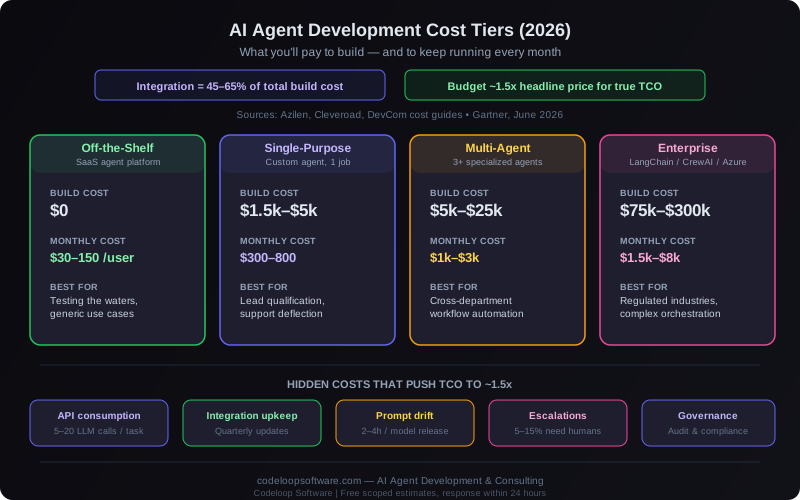
One number to internalize across all tiers: budget roughly 1.5x the headline price for total cost of ownership in year one. The gap comes from API consumption, integration upkeep, and the hidden costs covered below.
Agency vs In-House vs Freelancer vs No-Code DIY
The same agent can be built four ways, and the trade-offs are real. A US-based in-house AI engineer costs $150k+ per year before benefits — and most SMB agent projects need a team (engineer, integration developer, QA), not one person. Here's the honest comparison:
| Option | Typical cost | Pros | Cons |
|---|---|---|---|
| No-code DIY | $50–$500/mo + your time | Cheapest entry, fast prototyping | Hits a ceiling fast; brittle integrations; you own the maintenance |
| Freelancer | $2,000–$15,000/project | Low cost, direct communication | Single point of failure; availability and support after launch vary widely |
| In-house hire (US/EU) | $150k+/yr per engineer | Full control, deep product context | 3–6 month hiring cycle; expensive for a single project; needs a team anyway |
| Offshore agency | $1,500–$25,000/project | Full team (BA, dev, QA) at 30–50% of US rates; faster start; ongoing support | Requires vetting; time-zone overlap matters |
For most SMBs and mid-market companies, an experienced offshore agency is the value play: you get a full delivery team for less than half the cost of one US salary, with someone accountable for keeping the agent running after launch. The catch is vetting — we wrote a separate guide on how to choose an AI agent development company covering the questions that separate real agent builders from chatbot resellers.
The Hidden Costs Nobody Quotes You
The build quote is the visible part. These five costs show up after launch, and they're why total cost of ownership runs ~1.5x the headline price:
API consumption
Agents aren't chatbots — a single task typically triggers 5–20 LLM calls (planning, tool use, verification, retries). If your volume estimate is off by 2x, so is your API bill.
Integration maintenance
The APIs your agent depends on change. Plan for quarterly update cycles to keep CRM, helpdesk, and internal tool connections healthy.
Prompt drift
Every major model release changes behavior slightly. Expect 2–4 hours of prompt rework and regression testing per model release to keep output quality stable.
Escalation handling
Even well-built agents escalate 5–15% of cases to humans. That review workload is a real operating cost that belongs in your ROI math.
Governance and audit
In regulated industries (healthcare, finance, legal), logging, audit trails, and compliance reviews add both build cost and ongoing overhead.
How to Reduce AI Agent Costs
- Route to smaller models. Most agent steps (classification, extraction, formatting) don't need a frontier model. Routing routine steps to smaller, cheaper models can cut API spend 50–80%.
- Use prompt caching. Agents resend the same system prompt and tool definitions on every call — caching them slashes input token costs. The same techniques from our guide on cutting token costs in Claude Code apply to production agents.
- Watch the model market. Per-token economics keep improving — newer releases like Claude Fable 5, Anthropic's latest model, shift the cost-per-task math, so an agent designed to swap models easily keeps getting cheaper to run.
- Start with one workflow. A single-purpose agent that works beats a multi-agent vision that stalls. Prove ROI on one process, then expand with the savings.
- Clean your data first. A week of data preparation before the build is cheaper than a month of engineering workarounds during it.
The ROI Math: When Does an Agent Pay for Itself?
The right question isn't "what does it cost" — it's "what does it replace." A support agent that deflects 60% of 500 monthly tickets saves roughly 150 hours of human handling time. At a loaded cost of $30/hour, that's $4,500/month in capacity — against a $3,000–$5,000 build and a few hundred dollars a month to run. In our experience, most businesses see ROI within 2–3 months through reduced labor costs and faster response times.
The pattern holds across use cases: lead qualifiers that respond in minutes instead of hours, research agents that prep sales calls overnight, ops agents that reconcile data nobody wanted to touch. See the numbers in our roundup of real companies running operations with AI agents.
What $5k / $20k / $75k Actually Gets You
~$5,000 — One agent, one job, done well
A single-purpose agent with 2–3 integrations: a lead qualifier connected to your website forms and CRM, or a support deflection agent trained on your help docs with helpdesk handoff. Includes discovery, build, testing, and launch in 2–4 weeks. Running cost: $300–$800/month.
~$20,000 — A coordinated agent workflow
Three to five specialized agents working together: intake, research, drafting, and escalation across a full department process (e.g., inbound sales from first touch to booked meeting). Includes RAG over your internal knowledge, custom dashboards, and human-in-the-loop checkpoints. Typically 6–10 weeks. Running cost: $1,000–$3,000/month.
~$75,000+ — An enterprise agent platform
Custom orchestration on frameworks like LangChain, CrewAI, or Azure AI: dozens of integrations, role-based access, audit logging, compliance controls, and SLAs. This is the entry point for regulated industries and companies embedding agents into core products. Timeline: 3–6+ months. Running cost: $1,500–$8,000/month.
Key takeaway
AI agent pricing in 2026 spans $1,500 to $300,000 — but the spread isn't arbitrary. It tracks integrations, autonomy, and compliance. Scope one high-volume workflow, budget 1.5x the build quote for year-one TCO, and demand an ROI model before you sign. Done right, the agent pays for itself within a quarter.
Get an Exact Number for Your Project
Ranges are useful; a quote is better. At Codeloop, we build custom AI agents for US and EU businesses from our engineering hub in Ahmedabad, India — which is exactly why our pricing lands at the value end of every range in this article. Tell us the workflow you want to automate and we'll send back a scoped estimate with build cost, monthly running cost, and an ROI projection. Free consultation, response within 24 hours.
Get a Free Cost EstimateFrequently Asked Questions
How much does it cost to build an AI agent? +
In 2026, a custom single-purpose AI agent costs $1,500–$5,000 to build plus $300–$800/month to run. Multi-agent workflows cost $5,000–$25,000 plus $1,000–$3,000/month, and complex enterprise builds on frameworks like LangChain or Azure range from $75,000 to $300,000. Off-the-shelf agent platforms cost $30–$150 per user per month with no build fee.
Why do AI agent projects cost so much more than the platform fee? +
Because integration and orchestration account for 45–65% of total build cost. Connecting an agent to your CRM, helpdesk, and internal systems — and making it reliable — is where the engineering hours go. On top of that, agents make 5–20 LLM calls per task, so API consumption scales with usage. A realistic budget is about 1.5x the headline build price for year-one total cost of ownership.
Is it cheaper to build an AI agent in-house or hire an agency? +
For most SMBs, an agency is significantly cheaper. A US-based in-house AI engineer costs $150,000+ per year before benefits, and most agent projects need a team — engineer, integration developer, and QA. An experienced offshore agency delivers a complete single-purpose agent for $1,500–$5,000 and a multi-agent workflow for $5,000–$25,000, with ongoing support included. In-house makes sense once agents become core to your product.
What are the ongoing monthly costs of running an AI agent? +
Expect $300–$800/month for a single-purpose agent, $1,000–$3,000/month for multi-agent workflows, and $1,500–$8,000/month for enterprise systems. This covers LLM API consumption (agents make 5–20 calls per task), hosting, monitoring, quarterly integration updates, and prompt maintenance — typically 2–4 hours of rework per major model release.
How long does it take to build an AI agent? +
A single-purpose agent with 2–3 integrations takes 2–4 weeks from discovery to launch. Multi-agent workflows typically take 6–10 weeks, including RAG setup and human-in-the-loop checkpoints. Enterprise builds with compliance requirements and dozens of integrations run 3–6+ months. Data readiness is the biggest schedule variable — clean, accessible data can cut timelines significantly.