Claude Fable 5 Explained: Anthropic's First Claude 5 Model
On June 9, 2026, Anthropic released Claude Fable 5 — the first model in the Claude 5 family and the first publicly available model in a new "Mythos-class" tier that sits above Opus. Here is what is actually new, what is verified, and what it means if you are building AI agents.
Quick answer
Claude Fable 5 is the first model in Anthropic's Claude 5 family, released June 9, 2026. It belongs to a new Mythos-class tier that sits above Claude Opus in capability — Anthropic says its capabilities exceed any model it has ever made generally available. Fable 5 and Claude Mythos 5 share the same underlying model: Fable 5 is the generally available version with additional safety measures for dual-use capabilities (cybersecurity, biology and chemistry, distillation), while Mythos 5 is restricted to approved organizations with some of those safeguards lifted. It is priced at $10 per million input tokens and $50 per million output tokens, and you can use it today via the Claude API (model ID claude-fable-5), Claude Code, and claude.ai paid plans.
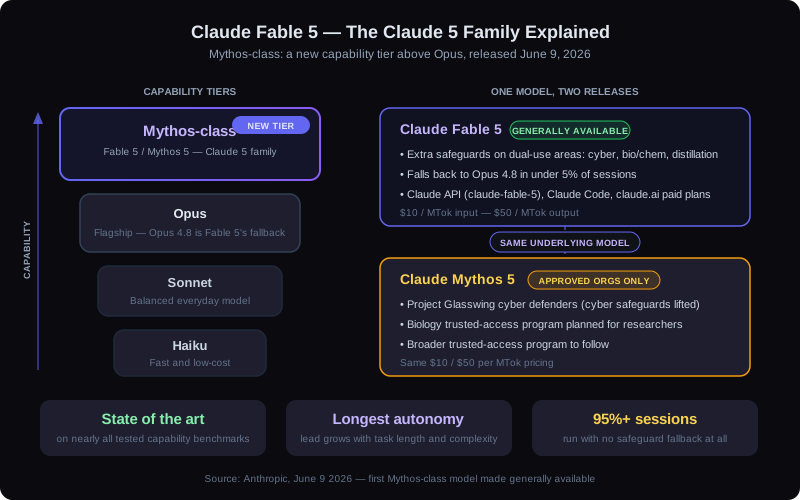
Mythos-class is a new tier above Opus — Fable 5 is the generally available version of it
What Is Claude Fable 5? The Claude 5 Family Begins
For the past two years, Anthropic's lineup followed a familiar ladder: Haiku for speed, Sonnet for balance, Opus at the top. Claude Fable 5 breaks that pattern. According to Anthropic's announcement, Fable 5 is a Mythos-class model — a tier above Opus-class — and the first Claude 5 model to ship.
The Mythos-class story started before the public launch. In April 2026, Anthropic began Project Glasswing, releasing the first Mythos-class model (Claude Mythos Preview) only to a limited group of cyber defenders and critical software infrastructure providers. Fable 5 is the moment that capability tier went public: as TechCrunch and CNBC covered it, Anthropic released a version of Mythos that the public can access — made "safe for general use" through added safeguards.
Anthropic's headline claims are specific: Fable 5 is state-of-the-art on nearly all tested benchmarks of AI capability, with exceptional performance in software engineering, knowledge work, vision, and scientific research. Two claims matter most for agent builders: the longer and more complex the task, the larger Fable 5's lead over other models, and it can work autonomously for longer than any previous Claude model.
Fable 5 vs Mythos 5: Same Model, Different Access
This is the part most coverage gets muddled, so let us be precise. Fable 5 and Mythos 5 are the same underlying model. The names even hint at it — Anthropic notes that "fable" comes from the Latin fabula, akin to the Greek mythos. What separates them is not capability but safeguards and access.
Claude Fable 5
Generally available to everyone via API, Claude Code, and claude.ai paid plans. Ships with additional safety measures for dual-use capabilities: queries in high-risk areas are answered by Claude Opus 4.8 instead. This fallback triggers in less than 5% of sessions on average.
Claude Mythos 5
Available only to approved organizations. Project Glasswing cybersecurity partners get it with cyber safeguards lifted, and a biology trusted-access program for select biomedical researchers is planned. A broader trusted-access program is intended to follow.
The dual-use safeguards on Fable 5 cover three areas:
- Cybersecurity — detecting queries about discovering and exploiting software vulnerabilities, plus agentic hacking patterns like reconnaissance and lateral movement
- Biology and chemistry — broad safeguards on most bio/chem requests, since Mythos-class models outperformed even protein-specialized models on unpublished tasks
- Distillation — blocking attempts to extract Fable 5's capabilities to train competing models
For everyday development work, the practical impact is small: Anthropic reports more than 95% of Fable sessions involve no fallback at all. The safeguards also held up under scrutiny — an external bug bounty found no universal jailbreaks in over 1,000 hours of testing, and Fable 5 complied with zero harmful single-turn cyberattack requests across 30 public jailbreak techniques.
What's New vs Claude Opus 4.x
Fable 5 isn't an Opus upgrade — it's a new tier above it. Opus 4.x remains Anthropic's workhorse flagship; Mythos-class is what comes after the top of the old ladder.
Here is how the two tiers compare on what has been publicly verified so far:
| Claude Opus 4.x | Claude Fable 5 | |
|---|---|---|
| Tier | Opus-class flagship | Mythos-class (above Opus) |
| Family | Claude 4 | Claude 5 (first model) |
| Input / output $/MTok | $5 / $25 (Opus 4.6) | $10 / $50 |
| Long, complex tasks | Strong | Lead grows with task length |
| Autonomous operation | Hours-scale sessions | Longest of any Claude model |
| Role in the lineup | GA flagship + Fable's fallback | GA Mythos-class, with safeguards |
Notice the relationship in that last row: Opus 4.8 is not being replaced — it literally serves as the fallback model inside Fable 5's safeguard system, and Anthropic's alignment assessment found Mythos 5's rate of misaligned behavior was low and similar to Opus 4.8's. The two tiers are designed to coexist, which also means model routing (Fable for the hard problems, Opus or Sonnet for routine work) is now a three-tier decision rather than two.
Benchmarks and Pricing: What's Verified So Far
It is early days, and we will only repeat figures with a source behind them. From Anthropic's announcement and launch-partner evaluations:
- State-of-the-art on nearly all tested benchmarks, per Anthropic, spanning software engineering, knowledge work, vision, and scientific research
- Top performer on Cognition's FrontierCode evaluation and the highest score on Hebbia's Finance Benchmark for senior-level reasoning
- First model to break 90% on Hex's core analytics benchmark for complex, long-running analytical tasks
- Nearly saturating ViBench, an end-to-end vibe-coding benchmark — relevant if you follow the vibe coding workflow
- Stripe reported Fable 5 "compressed months of engineering into days," completing a 50-million-line Ruby codebase migration in a day that would otherwise have taken a team over two months
Pricing
Claude Fable 5 and Mythos 5: $10 per million input tokens, $50 per million output tokens. That is double Claude Opus 4.6's $5/$25 rate, but less than half the price of the earlier Claude Mythos Preview. On subscription plans (Pro, Max, Team, seat-based Enterprise), Fable 5 was included at no extra cost from June 9-22, 2026, and requires usage credits from June 23 onward — Anthropic says it intends to restore it as a standard subscription feature later.
One detail we are deliberately not quoting: a context window figure. Anthropic's announcement does not headline one, and we have not found a verified number — so treat any specific claim you see elsewhere with caution until it appears in the official docs.
Claude Fable 5 in Claude Code
Fable 5 now powers Claude Code, and this is where the "lead grows with task length" claim becomes tangible. Long-horizon coding tasks — the multi-hour refactors and multi-agent team workflows we have covered before — are exactly where Anthropic says the gap over previous models is largest. One launch-partner CTO put it plainly: Fable 5 "delivers more capable engineering in fewer turns than prior models — handling the complex multi-agent workflows our employees run daily in Claude Code."
"Fewer turns" matters more than it sounds. Every turn an agent wastes on a wrong approach burns context and tokens. A model that gets to the correct fix in 3 turns instead of 7 compounds with everything in our 1M context window guide — large context plus stronger long-horizon reasoning is what makes the single-session workflow (research, plan, implement, verify) actually hold together on big codebases. And because Fable 5 costs 2x Opus per token, the habits in our token optimization guide — prompt caching, focused context, routing simple tasks to cheaper models — matter twice as much now.
What It Means for Businesses Building AI Agents
If you are evaluating AI agents for your business, Fable 5 changes two variables in the equation: reliability and economics.
Reliability. The main reason autonomous agents fail in production is not that models cannot write code or draft emails — it is that they drift, lose the plot, or make a bad judgment call somewhere in step 14 of a 20-step workflow. A model whose advantage specifically grows with task length and that can work autonomously longer than any previous Claude directly attacks that failure mode. Workflows that needed a human checkpoint every few steps can now plausibly run end-to-end.
Economics. At $10/$50 per million tokens, Fable 5 is the most expensive Claude per token. But per-token price is the wrong metric for agents — cost per completed task is what hits your budget. A model that finishes in fewer turns, makes fewer errors that need re-work, and escalates to humans less often can be cheaper per outcome despite the higher rate. We break down that math in our AI agent development cost guide; the short version is that model fees are usually a minority of total project cost, so a 2x token rate on the hardest 10% of tasks barely moves the total — while failed automations move it a lot.
The sensible architecture is tiered: Fable 5 for planning, judgment, and the long-horizon steps; Opus or Sonnet for routine execution. If you are outsourcing the build, this is a good litmus test — when choosing an AI agent development company, ask whether they are already building on the Claude 5 family and how they decide which tier handles which step. At Codeloop, model routing is a standard part of how we build custom AI agents.
How to Try Claude Fable 5
- 1. Claude API — use model ID
claude-fable-5. Available everywhere since June 9, 2026. - 2. Claude Code — switch with
/modeland give it a genuinely hard, long-horizon task. Short tasks will not show you the difference; a cross-cutting refactor will. - 3. claude.ai — available on Pro, Max, Team, and seat-based Enterprise plans (usage credits apply after the June 22 launch window).
- 4. Mythos 5 — only via Anthropic's trusted-access programs (Project Glasswing partners today, a biology program planned). For everyone else, Fable 5 is Mythos-class access.
Key takeaway
Claude Fable 5 opens the Claude 5 era with a new Mythos-class tier above Opus: the same model as Claude Mythos 5, made generally available through added dual-use safeguards. For agent builders, the headline is not a benchmark score — it is longer reliable autonomy and fewer turns per task, which changes both what agents can be trusted to do and what they cost per outcome.
Planning Your Next AI Agent Project?
At Codeloop, we design and build production AI agents on the Claude family — including tiered architectures that put Fable 5's reasoning where it pays off and cheaper models everywhere else. If you want to know what the Claude 5 family means for your roadmap, we can map it out with you.
Talk to Us About Your ProjectFrequently Asked Questions
What is Claude Fable 5? +
Claude Fable 5 is the first model in Anthropic's Claude 5 family, released June 9, 2026. It is a Mythos-class model — a new capability tier above Claude Opus — and the most capable model Anthropic has ever made generally available, with state-of-the-art results across software engineering, knowledge work, vision, and scientific research. It is priced at $10 per million input tokens and $50 per million output tokens.
What is the difference between Claude Fable 5 and Claude Mythos 5? +
They share the same underlying model — the difference is safeguards and access. Fable 5 is generally available with additional safety measures for dual-use capabilities (cybersecurity, biology and chemistry, and distillation), falling back to Claude Opus 4.8 in those areas in under 5% of sessions. Mythos 5 is available only to approved organizations, such as Project Glasswing cybersecurity partners, with some safeguards lifted.
Is Claude Fable 5 better than Claude Opus? +
Yes — Fable 5 belongs to the Mythos-class tier, which sits above Opus-class in Anthropic's lineup, and Anthropic states its capabilities exceed any previously released model, with the lead growing on longer and more complex tasks. Opus is not obsolete, though: it costs half as much per token ($5/$25 vs $10/$50 for Opus 4.6) and even serves as the fallback model inside Fable 5's safeguard system, so most teams will route between both tiers.
How do I access Claude Fable 5? +
Three ways: the Claude API using model ID claude-fable-5, Claude Code via the /model command, and claude.ai on Pro, Max, Team, and seat-based Enterprise plans. It launched June 9, 2026 and was included in subscriptions at no extra cost through June 22; from June 23 it requires usage credits. Claude Mythos 5 itself is restricted to approved organizations through Anthropic's trusted-access programs.
What does Claude Fable 5 mean for AI agent development? +
Stronger long-horizon reasoning translates directly into more reliable autonomous agents: Fable 5 can work autonomously longer than any previous Claude model and completes complex work in fewer turns. While its per-token price is 2x Opus, cost per completed task can be lower because fewer turns, fewer errors, and fewer human escalations are needed. The practical pattern is tiered routing — Fable 5 for planning and hard steps, Opus or Sonnet for routine execution.