How to Choose an AI Agent Development Company in 2026
Every agency now claims to "build AI agents." Most are reselling chatbot templates. This buyer's guide gives you a 5-criteria checklist, 10 first-call questions, and the red flags that separate real agent engineering teams from demo factories.
Quick answer
To choose an AI agent development company in 2026, evaluate five things: (1) shipped production agents with verifiable case studies, (2) depth across the modern agent stack — MCP, RAG, and orchestration frameworks, not just API wrappers, (3) a transparent pricing and scoping process, (4) a post-launch maintenance and monitoring plan, and (5) communication quality with real time-zone overlap. An agency that passes all five is rare; an agency that fails two or more will likely become part of Gartner's 40% project-cancellation statistic.
Why This Choice Matters More in 2026 Than Ever
Two Gartner predictions frame the stakes. First, 40% of enterprise applications will embed task-specific AI agents by the end of 2026 — up from less than 5% in 2025. If your competitors aren't already deploying agents, they're scoping them. Second, and more sobering: Gartner also predicts that over 40% of agentic AI projects will be canceled by the end of 2027 due to escalating costs, unclear business value, or inadequate risk controls.
Read those two together and the conclusion is obvious: adoption is exploding and nearly half the projects will fail. The same Gartner research notes widespread "agent washing" — vendors rebranding chatbots and RPA scripts as agents — and estimates only about 130 of the thousands of self-described agentic AI vendors are real. The single biggest controllable variable between the success column and the cancellation column is the partner you pick. Here's how to pick well.
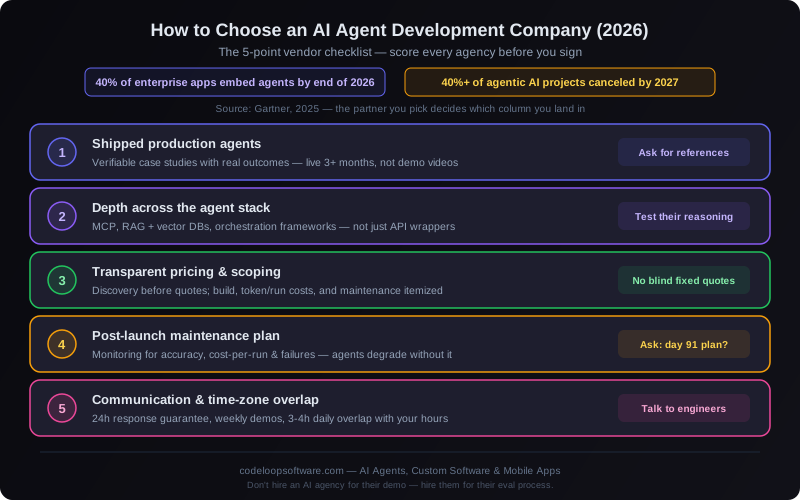
The 5-Criteria Evaluation Checklist
Score every agency you talk to against these five criteria. Be strict — a polished website and a slick demo satisfy none of them.
1. Shipped Production Agents — With Verifiable Case Studies
Anyone can build an agent that works in a demo. Production is different: real users, messy data, edge cases, and uptime expectations. Look for case studies with named outcomes — ticket deflection rates, hours saved, error rates — not vague "we transformed their business" copy.
- Ask for 2-3 case studies of agents running in production for 3+ months
- Ask what broke after launch and how they fixed it — honest teams have war stories
- Request a reference call with a current client if the engagement is large
2. Depth Across the Modern Agent Stack
A real agent team works fluently with MCP (Model Context Protocol), RAG pipelines and vector databases, and orchestration frameworks — and can explain when not to use each. If their entire stack is "we call the OpenAI API," you're paying agency rates for an API wrapper. See our framework comparison for what a serious team should be conversant in.
- MCP servers for tool integrations, not brittle one-off API glue
- RAG with proper chunking, retrieval evaluation, and a vector DB they can justify
- Current with the latest models — ask if they've worked with Claude Fable 5 and when they'd choose it over cheaper models
3. Transparent Pricing and a Real Scoping Process
Good agencies run discovery before quoting: they map your workflow, identify data sources, and define success metrics — then give you a number with assumptions attached. A fixed quote delivered an hour after your first call means they're guessing, and you'll pay for the guess in change orders. Benchmark any quote against our AI agent development cost guide before you sign.
- Line-item pricing: build cost, LLM/token costs, infrastructure, and maintenance separated
- A discovery or scoping phase — paid or free — before any fixed commitment
- Clear answers on what happens if scope changes mid-project
4. A Post-Launch Maintenance and Monitoring Plan
Agents are not websites — they degrade. Models get deprecated, APIs change, prompts drift, and accuracy erodes silently if nobody is watching. An agency with no answer to "what happens after launch?" is selling you a project, not a working system.
- Monitoring for accuracy, latency, cost-per-run, and failure rates — with alerting
- A defined maintenance retainer with response-time commitments
- A plan for model upgrades and re-evaluation when providers ship new versions
5. Communication and Time-Zone Overlap
Agent projects involve constant judgment calls — "should the agent escalate here or retry?" — that die in 48-hour email loops. You need an agency that responds fast, demos progress weekly, and overlaps your working hours enough for real conversations.
- Guaranteed response times (24 hours or better) in writing
- 3-4+ hours of daily overlap with your time zone for synchronous calls
- Direct access to the engineers building your agent, not just an account manager
10 Questions to Ask on the First Call
You don't need to be technical to vet an agency — you need the right questions and an ear for vague answers. Ask these on the first call:
- 1. Which agents have you shipped to production? Demos don't count — ask how long each has been live and what it handles daily.
- 2. How do you handle hallucinations and guardrails? Listen for grounding via RAG, output validation, confidence thresholds, and human-in-the-loop escalation.
- 3. How do you evaluate agent accuracy? A real team has an eval suite — test cases run on every change. "We test it manually" is not a methodology.
- 4. Who owns the IP, the code, and the prompts? The answer should be "you do, in full, including prompts and eval data" — in the contract.
- 5. What will this cost to run monthly? Token costs, infrastructure, and maintenance — separate from the build price.
- 6. What does the agent do when it's not sure? The right answer involves escalation paths and fallbacks, not "it always answers."
- 7. Which models and frameworks would you use for our case, and why? You want reasoning and trade-offs, not a single brand name for every problem.
- 8. How do you handle our data — security, privacy, and compliance? Essential for EU buyers: ask about GDPR, data residency, and whether your data trains anyone's models.
- 9. What happens in the first 90 days after launch? Monitoring, tuning cadence, and who fixes things at 2 a.m.
- 10. Have you ever told a client NOT to build an agent? The best agencies say no to bad use cases. If they've never turned work down, every problem looks like an agent to them.
"Don't hire an AI agency for their demo — hire them for their eval process."
Red Flags That Should End the Conversation
- Demo-only portfolios. Every showcase is a video or a prototype; nothing has real users. Production hardening is 70% of the work — they haven't done it.
- No eval or testing methodology. If they can't describe how they measure agent accuracy before and after changes, every deploy is a gamble with your customers.
- Promises of "fully autonomous" everything. In 2026, reliable agents still need guardrails, scoped permissions, and human escalation. Anyone promising zero oversight is selling the Gartner cancellation statistic.
- No mention of token or run costs. An agent that costs $4 per run on a workflow worth $2 is a money fire. If they haven't modeled unit economics, they haven't built at scale.
- Vague fixed quotes without discovery. A precise price for an undefined problem means the price is fiction — the real number arrives later as change orders.
Onshore vs Offshore vs Hybrid: An Honest Comparison
Geography drives price more than quality in 2026. The frameworks, models, and tooling are identical everywhere — what varies is rates, overlap, and process maturity. Here's the honest picture:
| Option | Typical rate | Pros | Watch out for |
|---|---|---|---|
| US / Western Europe | $150–300/hr | Same time zone, easy contracts, in-person option | 2-4x the cost; senior talent often subcontracted anyway |
| Eastern Europe | $50–100/hr | Strong engineering culture, good EU overlap | Less US overlap; mid-range pricing without mid-range guarantees |
| India | $25–60/hr | Best value; deep AI talent pool; full EU-morning + US-morning overlap possible | Quality varies widely — vet process and seniority hard |
| Hybrid (onshore PM + offshore build) | $60–120/hr blended | Local accountability with offshore economics | An extra layer between you and the engineers |
The honest take: geography is a price variable, not a quality variable. A senior India-based team with a rigorous eval process will outperform a junior US team every time — at a quarter of the cost. The real differentiators are process maturity and who actually writes your code. India-based teams with structured US/EU overlap and senior engineers on every project are the value pick in 2026; the failure stories almost always trace back to vetting price instead of process.
How Codeloop Scores on This Checklist
We'd be a strange buyer's guide if we didn't grade ourselves against our own criteria. Codeloop Software is an Ahmedabad, India-based agency founded by Amit Patolia (Founder & CTO), serving US and EU clients. Here's the honest self-assessment:
- Production track record: our agents run live for US/EU clients — see real case studies on this blog, with the outcomes and the failure modes included.
- Full agent stack: MCP, RAG with vector databases, Claude Code, OpenClaw, Paperclip, n8n, and LangChain — plus React/Next.js, Flutter, and React Native when the agent needs a product around it.
- Transparent pricing: we start with a free scoping consultation and quote with build, run-cost, and maintenance broken out — the same structure as our public cost guide.
- Post-launch plan: maintenance retainers with monitoring for accuracy, cost-per-run, and failures — agents are systems we operate, not projects we hand off.
- Communication: US/EU client base, structured time-zone overlap, and a 24-hour response guarantee — usually much faster.
Where we won't win: if you need a vendor in your building, or a 50-person enterprise consultancy with procurement departments, that's not us. We're the right fit when you want senior agent engineers, honest scoping, and offshore economics without the offshore communication tax.
The Bottom Line
AI agents will be embedded in 40% of enterprise apps by the end of this year, and over 40% of agentic projects will still get canceled. The difference isn't the technology — it's the partner. Score every agency against the five criteria, ask the ten questions, and walk away at the first red flag. The hour you spend vetting is the cheapest insurance in your AI budget.
Key takeaway
Vet process, not promises: verifiable production case studies, real stack depth (MCP/RAG/orchestration), transparent pricing with run costs, a maintenance plan, and fast communication with time-zone overlap. An agency that fails two of the five will likely cost you the project.
Want to Run the Checklist on Us?
Bring this article to a free consultation and ask us all ten questions — we'll give you straight answers, a scoped plan, and an honest "don't build this" if your use case doesn't justify an agent. We respond within 24 hours.
Book a Free ConsultationFrequently Asked Questions
How do I choose an AI agent development company? +
Evaluate five criteria: shipped production agents with verifiable case studies, depth across the modern agent stack (MCP, RAG, orchestration frameworks), transparent pricing with a real scoping process, a post-launch maintenance and monitoring plan, and strong communication with time-zone overlap. Ask for production references, an explanation of their eval methodology, and a breakdown of monthly run costs before signing anything.
How much do AI agent development companies charge? +
Rates vary by geography: US and Western European agencies charge $150-300/hour, Eastern European teams $50-100/hour, and India-based teams $25-60/hour. A focused single-use-case agent typically costs $10,000-50,000 to build, plus monthly costs for LLM tokens, infrastructure, and maintenance. Always get build cost and ongoing run cost quoted separately.
Should I hire an offshore AI development company? +
Offshore can be excellent value if you vet for process, not just price. The AI tooling is identical worldwide — what matters is senior engineers, a real eval methodology, and guaranteed communication overlap with your time zone. A senior India-based team at $25-60/hour with structured US/EU overlap and a 24-hour response guarantee will typically outperform a junior onshore team at 3-4x the rate.
What questions should I ask an AI development agency? +
The most revealing questions: Which agents have you shipped to production? How do you handle hallucinations and guardrails? How do you evaluate agent accuracy? Who owns the IP and the prompts? What will it cost to run monthly in tokens and infrastructure? What happens in the first 90 days after launch? And: have you ever told a client not to build an agent? Vague answers to any of these are a red flag.
How long does an AI agent project take? +
A scoped single-workflow agent typically takes 4-8 weeks from discovery to production: 1-2 weeks of scoping and data mapping, 2-4 weeks of build and evaluation, and 1-2 weeks of hardening and pilot. Complex multi-agent systems with deep integrations run 3-6 months. Be wary of both extremes — a "2-day build" skips evaluation, and an open-ended 12-month roadmap usually signals weak scoping.